Enterprise data volumes are doubling roughly every two years, driven by AI, IoT, and digital transformation initiatives. This makes a high-performance storage foundation the starting point for consolidating infrastructure, controlling costs, and giving AI and analytics workloads the data access they need to perform. Storage density, power efficiency, latency and throughput performance, scalability, and data reduction capabilities are all important components of a successful data management strategy. By investing in a current-generation storage architecture solution, businesses can enjoy significant data performance and management improvements. An objective analysis of the options—and verified performance information—can help decision-makers confidently select an efficient and cost-effective storage solution that could pay off both now and for years to come.
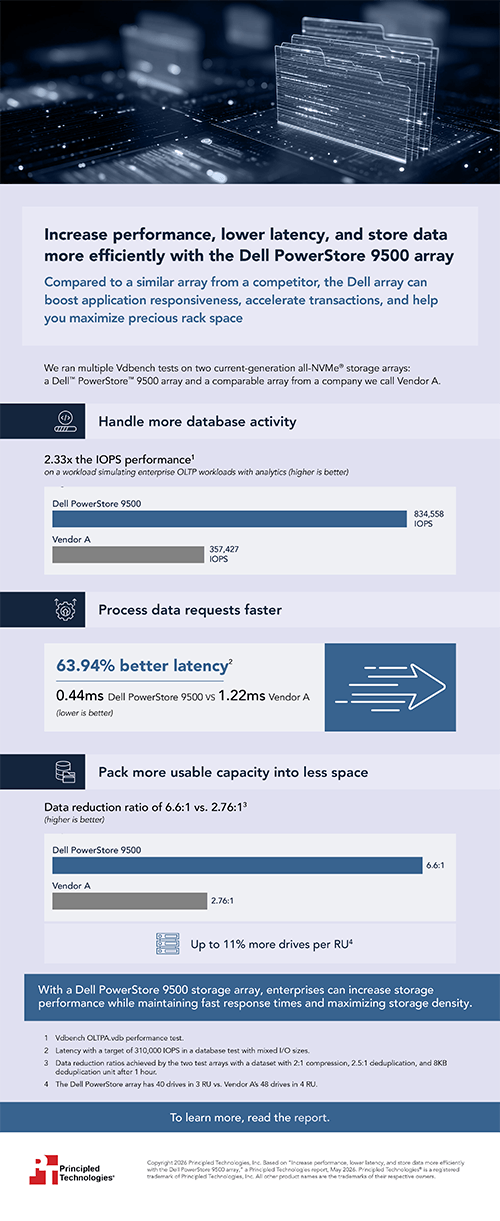
We used the Vdbench storage benchmarking tool—which simulates enterprise online transaction processing involving both analytics and database activity—to compare the input/output operations per second (IOPS), latency, and data reduction performance of a Dell PowerStore 9500 array and a current NVMe array from a competing vendor. In our tests, the PowerStore 9500 consistently outperformed the competitor array, delivering 2.33 times the IOPS performance, 63.94 percent lower latency, and 2.39 times the data reduction ratio.
The types of performance advantages that we saw in our comparison testing can translate into tangible benefits for IT organizations that invest in PowerStore 9500 arrays: faster transaction processing and improved user experience, higher VM and database consolidation ratios, reduced rack footprint and operational overhead, and greater flexibility to support emerging workloads such as analytics and AI. Choosing the Dell PowerStore 9500 can help organizations lower the total cost of ownership and simplify infrastructure while delivering the performance and scalability needed to keep pace with accelerating data growth and ever increasing business demands.
To learn more about our storage architecture performance tests and analysis, check out the report and infographic below.

Principled Technologies is more than a name: Those two words power all we do. Our principles are our north star, determining the way we work with you, treat our staff, and run our business. And in every area, technologies drive our business, inspire us to innovate, and remind us that new approaches are always possible.


